
Screens Aren’t Going Anywhere
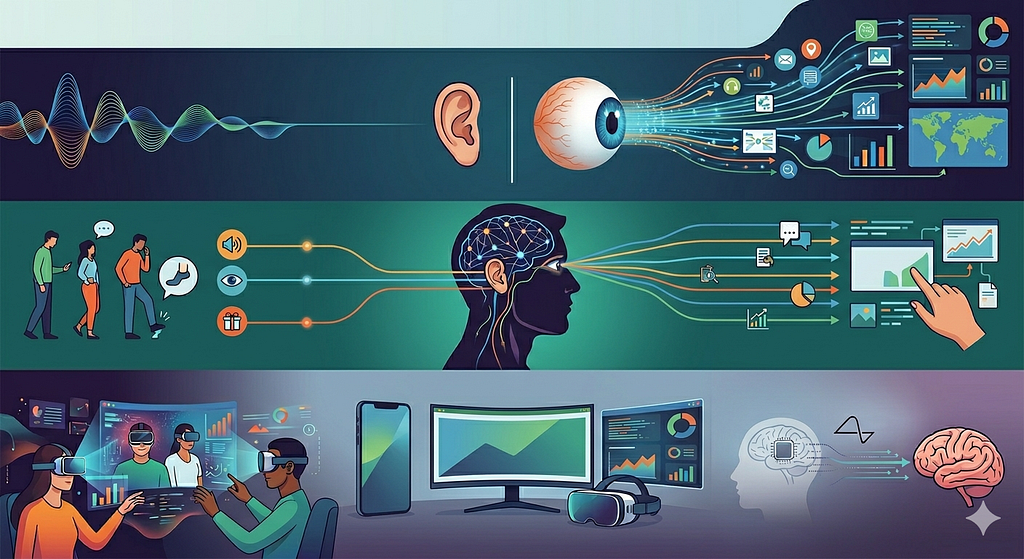
We are being told a story. The companies tell it, and the press repeats it
until repetition starts to feel like fact: the screen is dying. Soon, they
promise, we will simply speak to a machine and the machine will speak back, and the glowing rectangle that has defined a generation will quietly disappear. A world without screens, handed to us by artificial intelligence.
I do not believe it. And my reason is not sentiment. It is the one thing no
company can patch, no model can train around, and no roadmap can revise: the human body. We take in the world fastest through our eyes.
Reading is faster than listening. A single glance at a map says more than a
minute of careful description. A chart reveals a trend in a moment that a voice would labor through a paragraph to explain. This is not a habit we can be argued out of, and it is not nostalgia for the devices we already own. It is bandwidth. The eyes are without a doubt the widest channel we possess into the minds.
On the contrary, hearing is linear in terms of processing information. Sound arrives one word at a time, at a pace set by someone other than you, and it cannot be skimmed. You cannot leap to the part that matters, scan a list, weigh two things side by side, or hold five in view at once. Audio moves at the speed of the speaker. Sight moves at the speed of your own attention. That distance does not close because the voice on the other end has grown more clever.
And there is the error at the heart of the prophecy: it mistakes a breakthrough for a destiny. A machine that writes well, or speaks naturally, is a genuine achievement. But it changes only the source of the information, never the way a human being receives it. A better intelligence does not widen your ears. We will always want the world laid out before us. We will always want to see.
I will admit my own bias before I go further. As strange as I am, I can find a
person genuinely beautiful from the character of their voice alone. But I am the exception, and I know it. Nearly the whole of humanity’s sense of beauty and order has always run through the eyes far more powerfully than through the ears. That is how we were made. Hearing has helped us, as it always has — but across every age of our history, the blind man drew a far harder lot than the deaf one.
Consider the two senses as instruments. Hearing is a plain, monophonic thing: one note at a time, difficult to bend, to tap, to layer, with little you are free to change. Sight is a violin, a guitar, an entire orchestra — rich,
layered, alive. Each has its moment to shine. But there is a reason we fill our halls with strings and orchestras, and not with a single-string instrument that sounds only one note. The richer instrument prevails where it counts.
There are two honest exceptions, and I will not hide them.
The first is virtual and augmented reality. Should those systems become good enough, and cheap enough, to reach the whole public, the “screen” ceases to be a rectangle on a desk and becomes the world itself, wrapped around you. But mark this: it does not prove the prophecy right. It proves it more wrong. That future holds more visual information, not less. It is not a world without screens. It is a world that is nothing but screen.
The second is direct neural control — the brain interface, Neuralink and its
kin — where information would bypass the senses entirely and arrive straight inside the skull. That would truly break my argument. If a map can be poured into a mind without passing the eyes, then bandwidth is no longer the limit. I will only add, given the work I have done, that a machine reading and writing directly to the brain is not a future I find comforting. The eye, at least, can look away.
But both of these remain far off. Look honestly at where the world’s technology is actually moving — the money, the products being shipped, the real pace of the hardware — and neither cheap, universal VR nor a consumer brain interface is close. They are research directions, not the coming decade.
So until one of them arrives, the prophecy has it backward. Screens are not
vanishing. They will grow more capable, more present, more woven into
everything we do — because they feed the single sense that can still keep pace with us.
The voice in your ear is a fine companion. It was never going to replace the
thing before your eyes.
This piece was first published on Medium. Comments and claps live there.
Open on Medium